Guadalquivir and Mills route in Córdoba
3 min read
Written by official guides
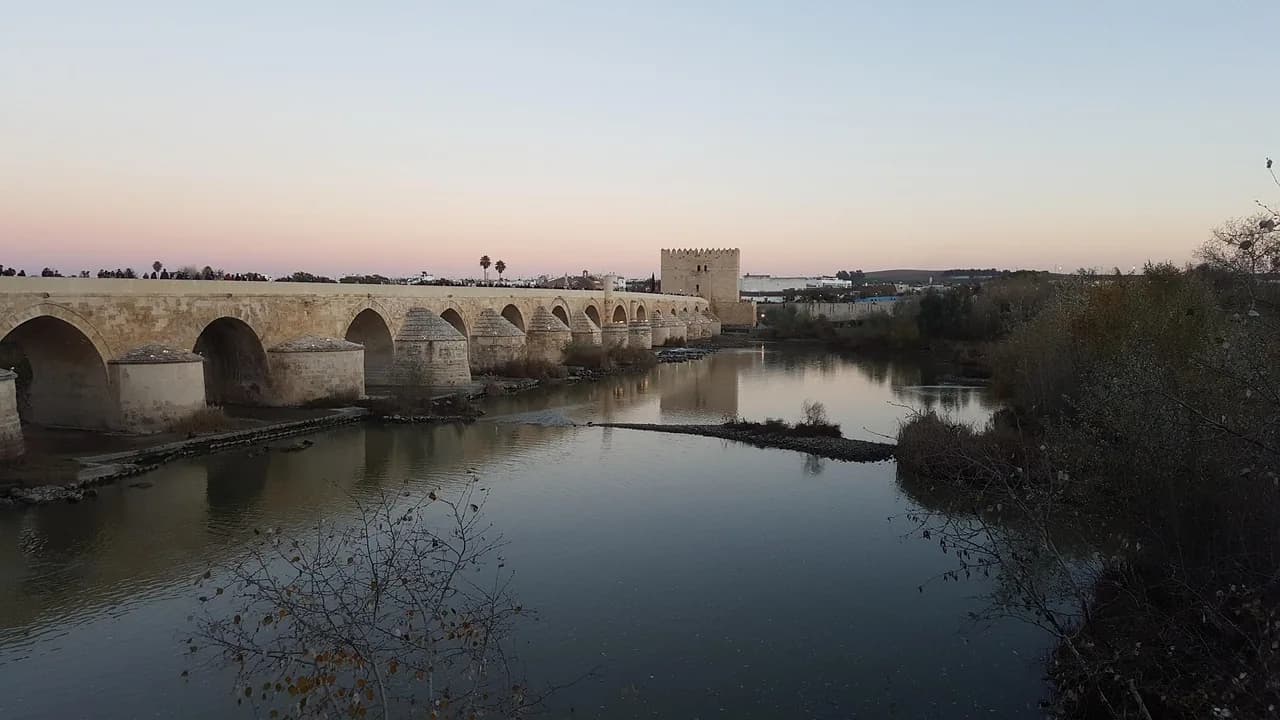
Córdoba came to have 11 flour mills along its stretch of the Guadalquivir, listed in the General Catalogue of Andalusian Historical Heritage since 2009 and mostly built between the 8th and 11th centuries. This route walks the stretch where the most mills are concentrated and best preserved, with 4 stops: the Roman Bridge, the Albolafia Mill, the Paseo de la Ribera and the Molino de Martos.
It is a short walk, about 16 minutes on foot one way not counting the stops, which combines well with a visit to the Mosque-Cathedral or can be done at sunset, when the light falls full on the river and the mills.
Route itinerary
1. Roman Bridge
Starting point of the route and a natural viewpoint over the river; it has its own page in this guide. From the bridge itself you can already see, midstream, the remains of the Pápalo (right side) and Enmedio (left side) mills, today half-hidden by vegetation. The next stop, the Albolafia Mill, is 2 minutes' walk away (130 metres).
2. Albolafia Mill
The best-known of the Cordoban mills, present on the city's coat of arms, with origins in the Roman period and later development in the Islamic period. Its history is covered on its own page. From here begins the Paseo de la Ribera, walked in about 12 minutes (900 metres) to the last stop.
3. Paseo de la Ribera
The stretch of riverside promenade along which several of the city's historic mills are spread, with the river on one side and the historic centre on the other. It has its own page in this guide. Downstream, on the opposite bank, you can also identify the Molino de San Antonio. The promenade leads directly to the last stop.
4. Molino de Martos (Hydraulic Museum)
The route closes at the Molino de Martos, 2 minutes (150 metres) from the previous stretch of the promenade, today converted into the Hydraulic Museum of Córdoba. It is one of only two mills on the river that can be visited inside; the other is the Molino de la Alegría, converted into a palaeobotanical museum within the Botanical Garden. According to tourist sources, it opens from 10:00 to 15:00, closes on Mondays and the ticket costs 2 euros (1.30 euros reduced), although its opening depends on the season and on arranged visits, so it is worth checking before going, especially in summer.
How long this route takes and how to do it
The walk between the 4 stops adds up to about 16 minutes. With time for photos on the bridge and at the Albolafia Mill, and if the Molino de Martos is open, the full visit takes between 45 minutes and an hour and a half. It is a route that can be done at any time, but sunset is the moment with the best light for seeing the bridge, the Mosque-Cathedral and the river together from the bank.
Tips for doing this route
Comfortable footwear: the Roman Bridge has a worn stone surface and can be slippery if it has rained. In summer there is little shade on this stretch of the river, so carry water and sun protection, or do the route first thing in the morning or last thing in the day. If you want to go inside the Molino de Martos, it is best to confirm by phone beforehand whether it is open that day, because it is not open all year.
It is the shortest of the three routes, and also the only one in this series focused on the river. It can easily be extended to the Molino de la Alegría, in the Botanical Garden, for those who also want to see the city's second museum-mill.
Book your guided tour
Want to discover it with an official guide who explains it to you in person?