Plaza de la Trinidad
Written by official guides
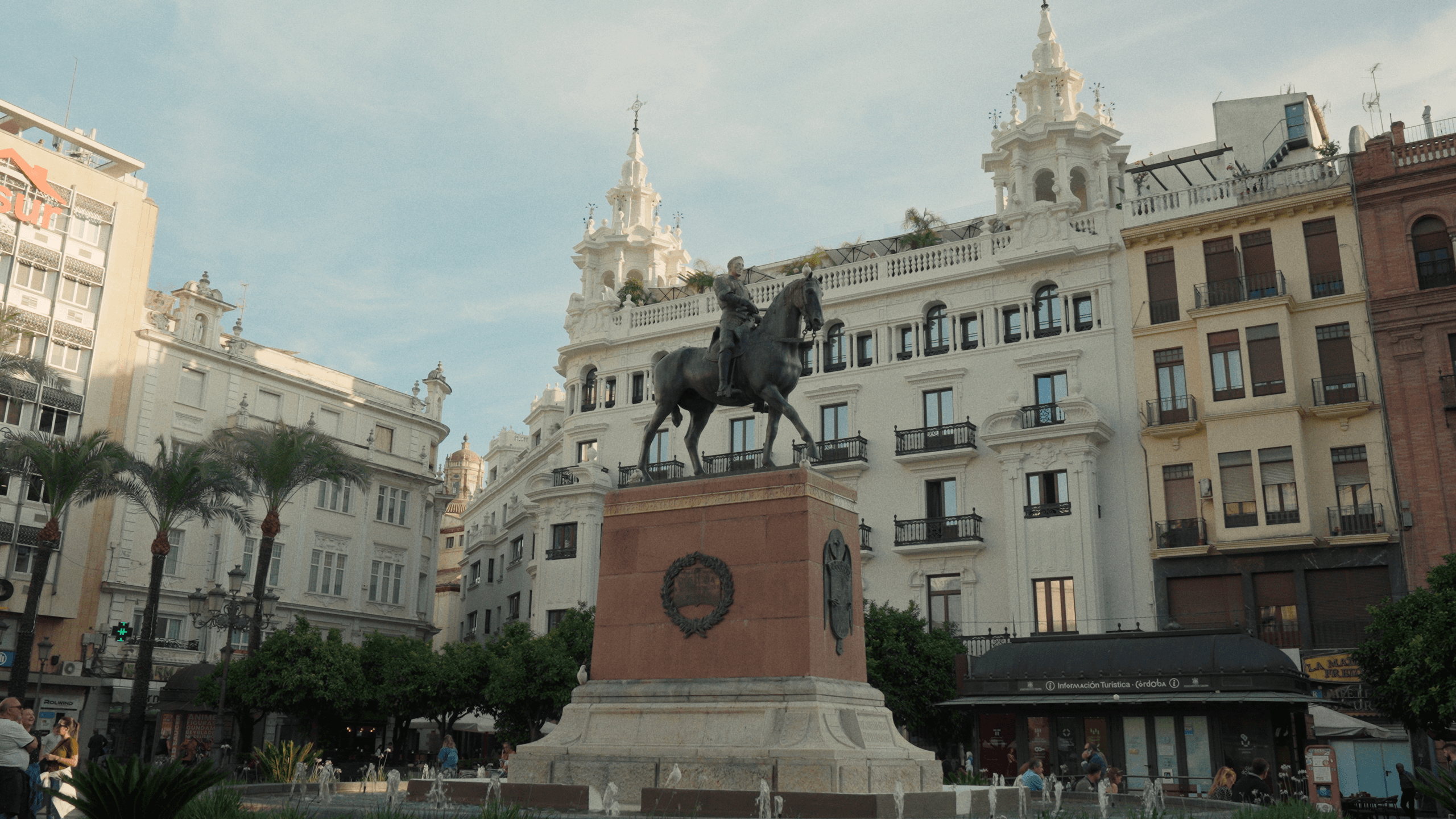
Plaza de la Trinidad is a pedestrian square in the historic centre of Córdoba, on the stretch connecting the Jewish Quarter with the city centre. It is named after the church of San Juan y Todos los Santos, a former Trinitarian convent, but for anyone strolling around the area it works above all as a crossroads between narrow lanes and busier streets such as Tesoro or San Felipe.
The square is bounded by Lope de Hoces, Sánchez de Feria, Horno de la Trinidad and Tesoro streets. It is also the place where the poet Luis de Góngora, one of Córdoba's most illustrious sons, died, which has made this corner a regular stop for those following his trail around the city.
Plaza de la Trinidad on the map of Córdoba
Placing Plaza de la Trinidad on the map of Córdoba helps to understand what it is for, beyond its monuments. It lies right between the network of the Jewish Quarter, reached via Calle Lope de Hoces towards the Puerta de Almodóvar, and the more commercial streets leading to the centre, such as Calle Tesoro, which connects with Plaza de Ramón y Cajal and from there with areas such as San Felipe or Tendillas.
That is why many of those who cross the square do not do so to visit it, but because it is the natural path between two very different areas of the city: the narrow, winding layout of the Jewish Quarter and the somewhat more open streets of the centre. That crossroads function explains why, although it is flanked by buildings with centuries of history, many pass through it without stopping, on their way to the Mosque or Plaza de la Corredera.
History of the square and its surroundings
The origin of the square is linked to the convent of the Santísima Trinidad, founded by the Trinitarians shortly after the Christian conquest of the city by Ferdinand III in 1236, with the foundation of the convent dated 1241. The original building suffered several collapses and reconstructions over the centuries: the church that occupies the square today, attributed to the architect Francisco Hurtado Izquierdo, was inaugurated on Trinity Sunday 1705, with a façade dated 1703 that introduced Solomonic columns to Córdoba.
The square was also the final setting of the life of Luis de Góngora. The poet died on 23 May 1627 in a house on what was then Calle de las Campanas, today Calle Sánchez de Feria, one of the boundaries of the square. A plaque on the church façade recalls the fact and, opposite it, facing the former Palace of the Dukes of Hornachuelos, a bronze monument to the poet by the sculptor Amadeo Ruiz Olmos has stood since 1967, inaugurated precisely on a 23 May.
So whoever crosses the square today on the way to the Jewish Quarter or the centre passes, without necessarily knowing it, the place where Góngora took his last steps, turned centuries later into an obligatory stop on any literary route around Córdoba.
What to see in Plaza de la Trinidad
The Church of San Juan y Todos los Santos
The church that presides over the square, dedicated to San Juan y Todos los Santos, is a reference of Cordoban Baroque. Its interior is a single nave, covered with a barrel vault and lunettes with windows, and its main façade, from 1703, introduced the use of Solomonic columns to the city for the first time.
The main altarpiece, commissioned in 1724 from the sculptor Juan Fernández del Río, is considered one of the peak pieces of Cordoban Baroque for the detail of its ornamentation. The church occupies the site of the former convent of La Trinidad, founded in 1241, of which hardly any visible remains survive after successive reconstructions.
The tower of Islamic origin
A few steps from Plaza de la Trinidad, in the neighbouring Plaza de San Juan, survives one of the oldest minarets in Córdoba: that of the former mosque of San Juan, built in the mid-9th or early 10th century, in the transition between the Emirate and the Caliphate (not from the Almohad period, as is sometimes stated). It is not the tower of the church of La Trinidad itself, but an independent building, today integrated into the church of San Juan de los Caballeros.
The tower, square in plan, 3.70 metres a side and 10.92 metres high, keeps twin horseshoe arches on marble columns of Visigothic origin, and has been listed as a historic-artistic monument since 1931. It is a quick but recommended stop for anyone already in the area, before or after visiting Plaza de la Trinidad.
The access streets from the Jewish Quarter
From the Jewish Quarter, the most direct access to Plaza de la Trinidad is via Calle Lope de Hoces, which links with the Puerta de Almodóvar, one of the old entrance gates to the Jewish district. It is a short walk, through narrow streets typical of the medieval layout, that opens naturally onto the square.
The square itself also borders Sánchez de Feria, Horno de la Trinidad and Tesoro streets, making it a crossroads of several pedestrian itineraries of the historic centre, both for those coming from the Jewish Quarter and for those heading to the centre.
How to get to Plaza de la Trinidad
Plaza de la Trinidad works as a hinge between the Jewish Quarter and the centre of Córdoba, which makes it an almost obligatory crossing on any walk through the historic centre. From the network of the Jewish Quarter you arrive via Calle Lope de Hoces to the Puerta de Almodóvar; in the opposite direction, Calle Tesoro connects the square with Plaza de Ramón y Cajal and, from there, with the San Felipe and Tendillas area.
This double connection explains why it is worth bearing in mind when planning a walking route through Córdoba: it serves both as a starting point towards the Jewish Quarter and the Mosque and as a link towards Plaza de la Corredera and the shopping centre. It is not a square designed to be reached by car, but to be crossed on foot between one area and another.
The best way to understand the role of Plaza de la Trinidad as a crossroads is to walk through it, within a wider route through the historic centre. The Free Tour of Córdoba, lasting about 2 hours and with a voluntary tip of between 10 and 15 euros per person, covers this kind of transitional corner between the Jewish Quarter and the centre, with explanations about its history and its urban function.
It is a flexible option for those who want to get to know Córdoba without committing in advance to a fixed price, and a good starting point before setting aside time for more specific visits, such as the Mosque or the Palacio de Viana.
Book your guided tour
Want to discover it with an official guide who explains it to you in person?