
Plaza de San Agustín
Written by official guides
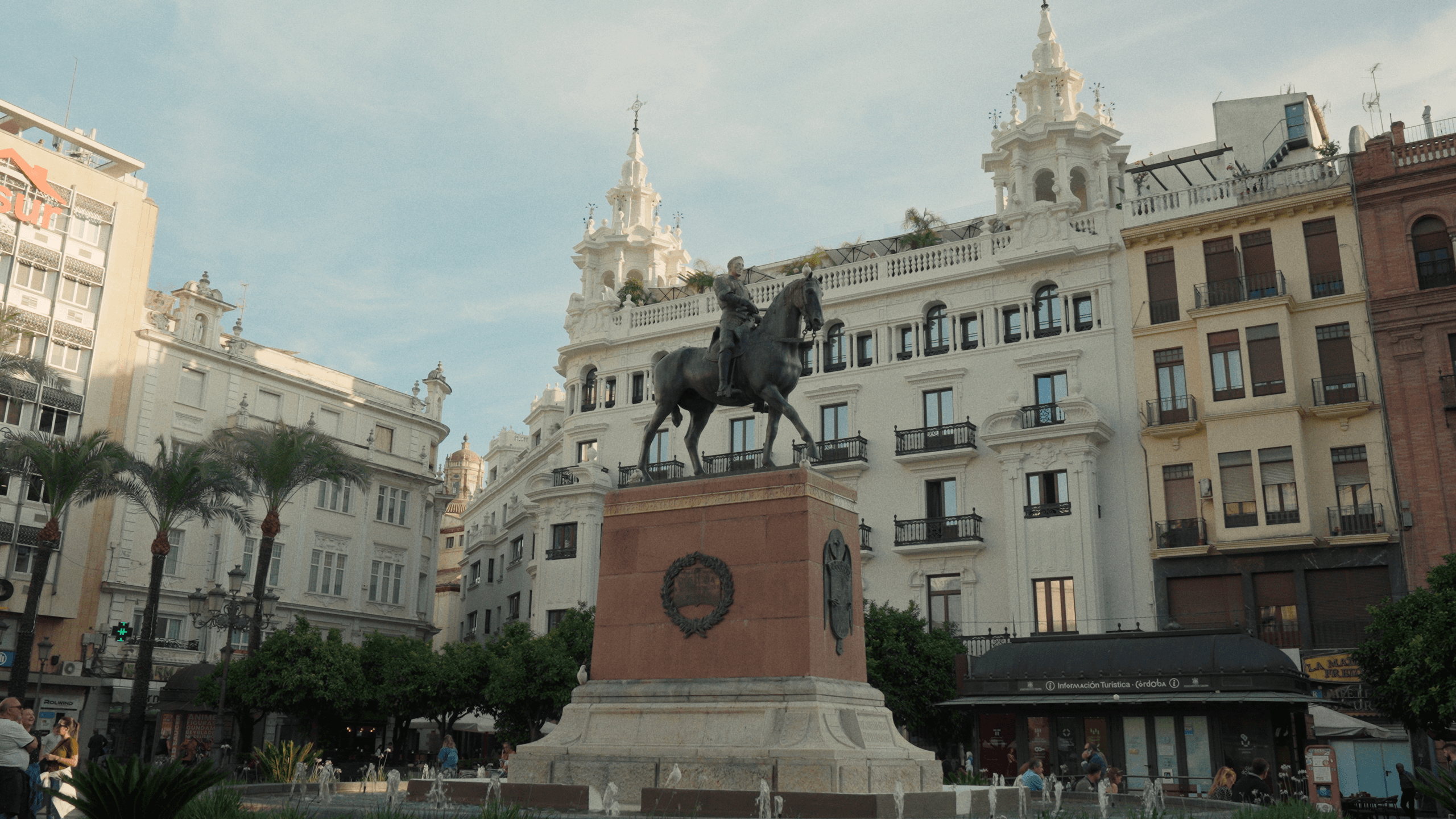
In the heart of the Santa Marina district, a short walk from the Palacio de Viana, Plaza de San Agustín is one of those corners of Córdoba that hardly anyone includes in their itinerary. It bears the name of the convent church that presides over one of its sides, but since its remodelling it is, above all, a quiet pedestrian space designed for a moment's pause.
There are no big signs or queues of visitors: only palm trees, a floor of Cordoban pebble paving and a Baroque façade that has looked onto the square for centuries. This is what you need to know before going.
History of Plaza de San Agustín
The origin of this space is linked to the Augustinian convent that gives the square its name. The order arrived in Córdoba after the conquest by Ferdinand III in 1236 and first settled next to the Guadalquivir, in the Campo de San Julián, but the insecurity of the area led them to request a move into the city. Pope Clement V authorised that change in 1313, and in 1328 the Augustinians settled permanently in the Santa Marina district, where they built their church and convent.
During the following centuries the convent enjoyed its period of greatest activity. In 1558 the Brotherhood of Nuestra Señora de las Angustias was founded, and in 1626 the sculptor Juan de Mesa made the titular image that today presides over the façade. The Augustinians taught philosophy and theology and came to have one of the first printing presses in the city, which made the area around the square a cultural and religious reference point.
The Peninsular War seriously damaged the building, occupied by Napoleonic troops, and Mendizábal's disentailment in 1836 brought the expulsion of the Augustinians and the sale of their property. In 1903 Bishop Pozuelo ceded the church to the Dominicans, who began its recovery. It was declared a Historic-Artistic Monument in 1983 and underwent a major restoration between 1981 and 2009, with an investment of 3.6 million euros, which allowed it to reopen on 9 October 2009.
The square you walk through today is, on the other hand, much more recent. Between October 2015 and March 2016 a comprehensive remodelling turned it into a practically pedestrian space: the perimeter wall that raised it above street level was demolished, the parking spaces were removed and only the southern road was left open to traffic. The works, valued at 617,000 euros and completed in five months, left a floor of Cordoban pebble paving framed in Sierra Elvira marble, which is what visitors walk on today.
What to see in Plaza de San Agustín
It is not a square designed as a tourist showcase, and that is precisely what makes it different from other busier corners of Córdoba. The Cordoban pebble paving, the date and Washingtonia palms in the centre and the plane trees planted around 1854 on the perimeter make up a serene space where the church is not the only protagonist.
It is worth pausing a moment before moving on, because between the Baroque façade, the layout of the district and the historic street furniture around the square there are several details that usually go unnoticed by those who only pass through on their way to another monument.
The façade of the Church-Convent of San Agustín
The current façade is the result of 16th- and 17th-century reforms, which added to the original Gothic structure a succession of arches and Corinthian columns topped by a broken pediment. That ensemble houses the image of Nuestra Señora de las Angustias, a work by Juan de Mesa from 1626, one of the most venerated pieces in the church. The interior keeps three naves with polygonal apses and ribbed vaults, with the central nave covered by an elliptical barrel vault dotted with lunettes.
The San Agustín district
The square gives its name to its own district, part of the Centro district and bordering Santa Marina and San Lorenzo, within the historic centre of Córdoba. Its narrow streets and quiet layout contrast with the bustle of the Jewish Quarter or the surroundings of the Mosque, and keep the residential character it has had since the Reconquest, when it took shape around the Augustinian convent.
The bust of Ramón Medina
On one side of the square, near the church, is the bust dedicated to the composer Ramón Medina Ortega (1891-1964), a work by the sculptor Amadeo Ruiz Olmos inaugurated in 1993. Medina, born in Brihuega but adopted by Córdoba, is the author of such popular pieces as 'Caminito de Santo Domingo', 'Cordobesita' or 'Campanas de la Mezquita'. During the remodelling of the square the bust was moved to its current position, leaving the central space clear.
Opening hours and access
The square is an open public space with no closing time: you can walk through it at any time of day.
The Church of San Agustín, run by the Dominicans, keeps the following worship hours: mass on weekdays at 9:00, vespers on Saturdays at 19:30 and mass on Sundays and public holidays from 10:30 to 13:00. The church's address is Plaza de San Agustín, 7.
How to get to Plaza de San Agustín
The square is in the district that bears its name, within the historic centre and very close to the Palace of the Marquises of Viana, in the network of streets separating the Jewish Quarter from the Ribera area. It is not right next to the Mosque-Cathedral like other points of the old town, but a little further north, in an area with fewer visitors.
To get there, the simplest thing is to walk from the Mosque or Jewish Quarter area northwards, through the network of streets of the Santa Marina district until you reach the square. It is a good point to combine with a visit to the Palacio de Viana, a short walk away in the same district.
Because of its location, some way from the most touristic core of the Mosque, Plaza de San Agustín fits better as a stop within a wider route around Córdoba than as a destination in itself.
The Free Tour of Córdoba covers the historic centre for about 2 hours with a guide, with a suggested voluntary tip of 10 to 15 euros per person, and includes references to districts like this one that lie outside the usual circuit. It is the most flexible way to discover corners like Plaza de San Agustín without advance booking or a fixed outlay.
Book your guided tour
Want to discover it with an official guide who explains it to you in person?