San Basilio district
4 min read
Written by official guides
The San Basilio district, also called Alcázar Viejo, occupies the bank of the Guadalquivir at the south-western end of Córdoba's Centro district, right next to the Alcázar of the Christian Monarchs and the Royal Stables. Its three streets, Postrera, Enmedio and San Basilio, are straight and parallel to each other, a layout that breaks with the maze of alleys in the rest of the historic centre and has its origin in the wall that in the Andalusi period separated this suburb from the Muslim Alcázar.
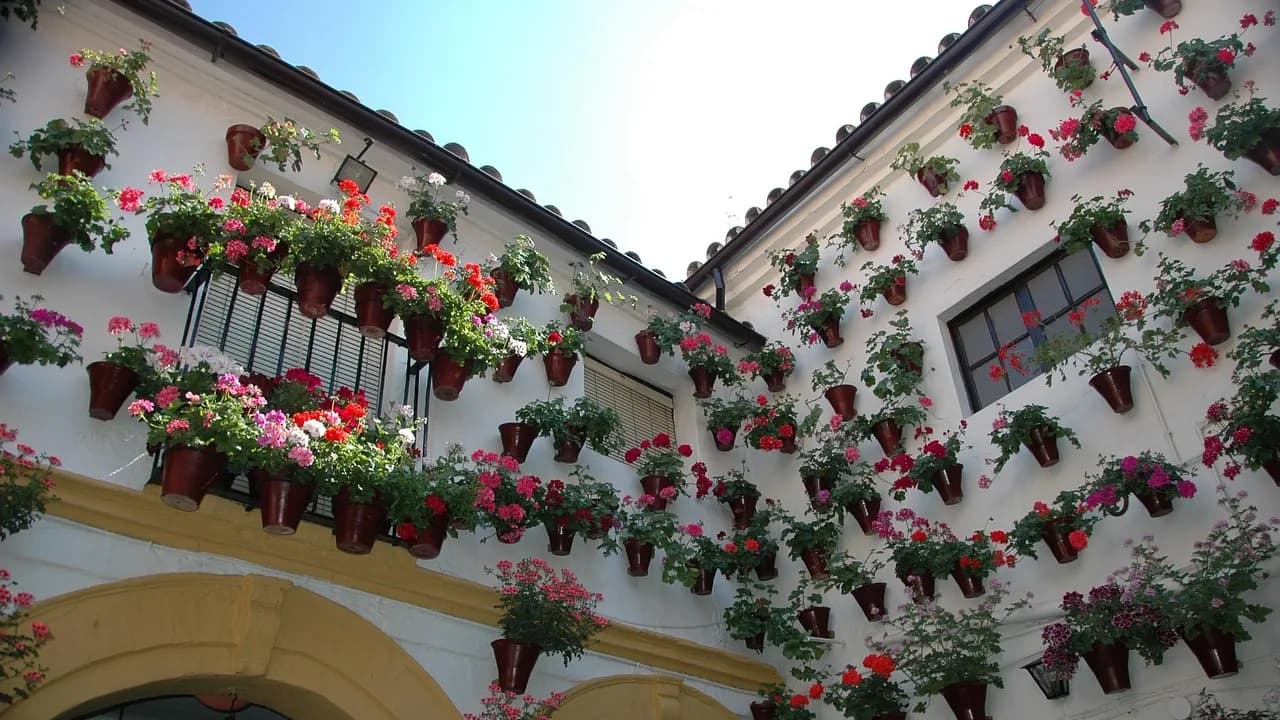
Unlike the Jewish Quarter, with its narrow streets and medieval Hebrew origin, San Basilio is recognised today by another hallmark: it is the neighbourhood with the most open patios in Córdoba and, according to the figures of the Municipal Patios Competition, the one that receives most visits during the festival declared Intangible Cultural Heritage of Humanity by UNESCO in 2012.
History of San Basilio
The origin of the neighbourhood lies in the last years of Al-Andalus in Córdoba. The area, then known as the Castle of the Jewish Quarter, was inhabited by a Jewish population protected by the Crown until the pogrom of 1391, which also affected other Castilian cities. In 1399 the Council asked King Henry III of Castile for permission to repopulate the area, and the settlement of crossbowmen charged with defending the nearby Royal Alcázar was authorised. The Jewish converts who remained in the neighbourhood would end up moving to San Nicolás de la Villa for health reasons.
The housing was then organised along three parallel streets, Postrera, Enmedio and San Basilio, the last named after the church of Nuestra Señora de la Paz, whose co-titular is Saint Basil the Great. The church was originally the convent house of the Basilian monks, founded in 1590, and did not become a parish until 1846, after the disentailment of the convent. The neighbourhood was protected by its own stretch of wall, with the Puerta de Sevilla and the Arco de Caballerizas as entrances, and by the Torre de Belén, a fortified gate of the Almohad period converted into a hermitage.
According to the municipal census, San Basilio had 837 inhabitants in January 2022, one of the least populated neighbourhoods in the Centro district despite its tourist and heritage weight.
What to see in San Basilio
San Basilio can be walked in little more than an hour, although it is worth allowing extra time to peek into its patios and the stretches of wall still standing.
1. Postrera, Enmedio and San Basilio streets
They are the backbone of the neighbourhood and the setting of the Cordoban Patios Competition every May. Behind the whitewashed façades hide the patios with the most history in the city: in the 2026 edition, Calle San Basilio was the street with the most award-winning patios in the whole competition, with first and second places in several categories, among them San Basilio, 44, first prize in Singular Patios worth 3,000 euros. In that same edition, San Basilio was the most visited neighbourhood of the competition, with 16,770 visits spread across its 12 participating patios.
2. Torre de Belén
A fortified gate of Almohad origin, recognisable by its horseshoe arches, which formed part of the Alcázar's defensive system and over time became a hermitage. It is one of the few remains of the Andalusi wall that can still be seen standing within the neighbourhood.
3. Puerta de Sevilla and Arco de Caballerizas
The Puerta de Sevilla, on Avenida Conde de Vallellano at Calle San Bartolomé, was from the Middle Ages the most direct way out towards that province and today still serves as the main entrance to the neighbourhood; opposite it stands a sculpture dedicated to Ibn Hazm. The Arco de Caballerizas, at the end of Calle Caballerizas Reales, is the other gate through the 14th-century wall built to defend the Alcázar of the Christian Monarchs.
4. Church of San Basilio
The former convent house of the Basilian monks, built in 1590, keeps three naves and a wooden roof. It is the seat of brotherhoods with their own Holy Week procession and the church that ended up giving its name to the whole neighbourhood.
How to get to San Basilio
San Basilio is less than ten minutes' walk from the Mosque-Cathedral, skirting the Alcázar of the Christian Monarchs and the Royal Stables to the Puerta de Sevilla. As it is a small neighbourhood integrated into the historic centre, the usual way to explore it is on foot; no city bus stop has been confirmed within its own streets.
The neighbourhood is worth visiting at any time of year, although May is the month when its patios open wide for the municipal competition; many of them remain open the rest of the year with reduced hours. San Basilio combines well with a visit to the Alcázar of the Christian Monarchs, the Royal Stables or a stroll along the Guadalquivir riverbank to the Roman Bridge.
Book your guided tour
Want to discover it with an official guide who explains it to you in person?