San Pedro district
4 min read
Written by official guides
The San Pedro district is in the southern part of Córdoba's Centro district, within the Axerquía or lower town, the sector that extended east of the old Muslim Medina. It borders La Magdalena and San Andrés-San Pablo to the north, Santiago to the east, El Salvador y la Compañía to the west, and San Francisco-Ribera to the south.
Unlike other districts of the historic centre, San Pedro was for centuries the commercial and industrial heart of the city: Córdoba's most important market was concentrated here and the offices of the Civil Government and the Provincial Council came to be based here. That character survives today in Plaza de la Corredera, the great arcaded square that shares the limelight with the church that gives the district its name.
History of San Pedro
The origin of San Pedro goes back to a Muslim suburb outside the walls of the Medina, inhabited by a mixed population of Muslims and Mozarabic Christians. From that period survive the Arab Baths of San Pedro, probably built in the 10th century under the rule of Almanzor and declared an Asset of Cultural Interest in 1931.
After the Christian conquest of Córdoba by Ferdinand III in 1236, the city was reorganised into fourteen parishes: seven in the old Villa and seven in the Axerquía. San Pedro was one of those seven Axerquía parishes, together with Santa Marina, San Andrés, San Lorenzo, Santiago, La Magdalena and San Nicolás de la Ajerquía. Each parish took the name of the church built at its centre between the late 13th and early 14th centuries, on earlier temples and mosques.
The parish grew under the protection of noble families such as the House of Aguayo and the House of Ríos, the latter linked to the conquest of the city and founder of convents such as Santa Cruz. Over the centuries, San Pedro established itself as the main commercial and industrial nucleus of Córdoba, a character reinforced in 1683 with the construction of Plaza de la Corredera as an arcaded main square.
What to see in San Pedro
1. Plaza de San Pedro and its basilica
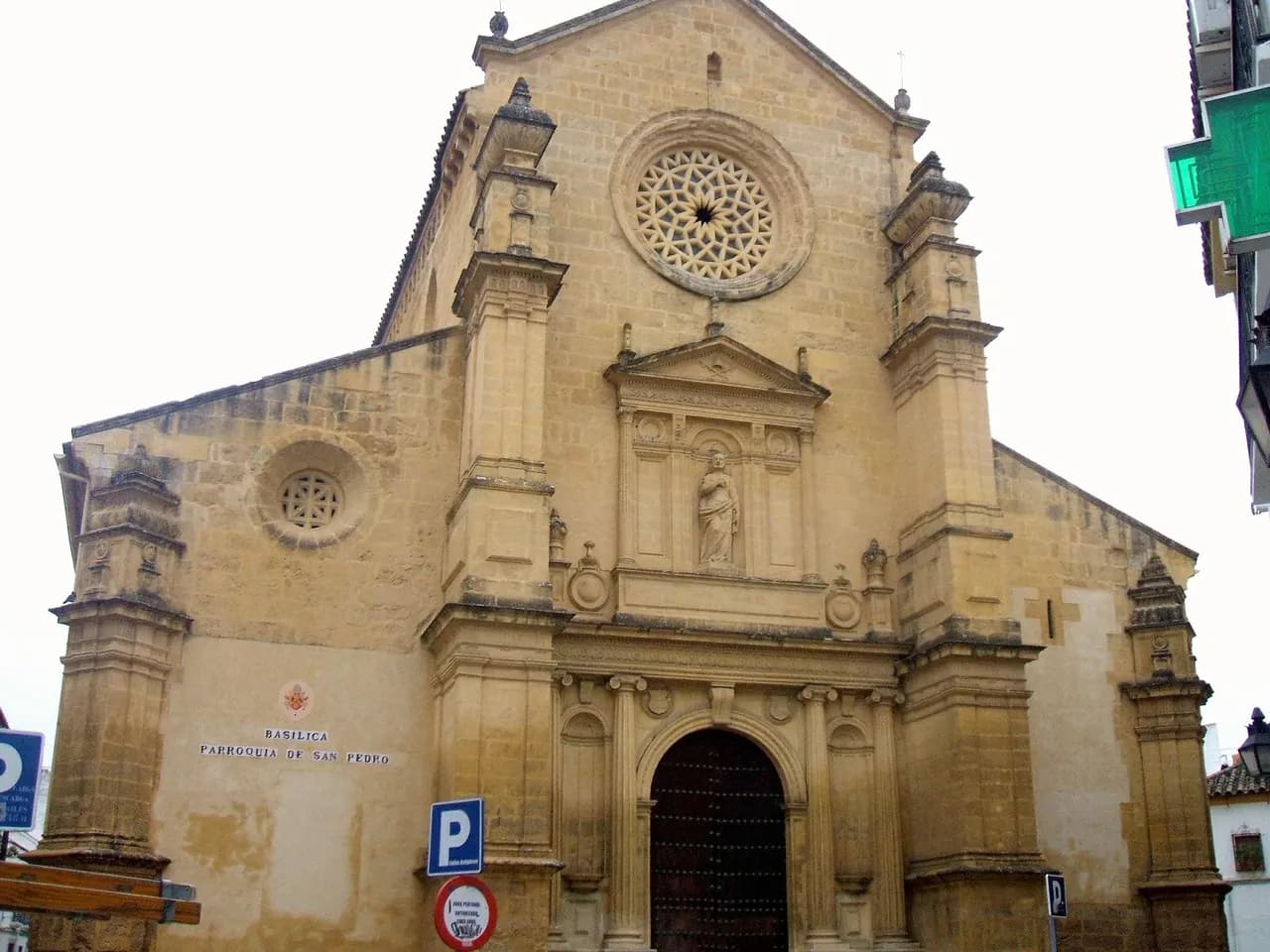
Plaza de San Pedro occupies the old parish cemetery and keeps a Baroque fountain placed in 1647. In it stands the Basilica of San Pedro, built between the late 13th and early 14th centuries on a 4th-century early Christian temple that held the remains of the Cordoban martyrs Faustus, Januarius and Martial, found in 1575. Its main façade, from 1542, is by Hernán Ruiz II. The Holy See raised it to minor basilica in 2006.
2. Plaza de la Corredera
Built in 1683 by the architect Antonio Ramos Valdés on the commission of the magistrate Francisco Ronquillo Briceño, Plaza de la Corredera is the only rectangular, arcaded Castilian-style main square in Andalusia. Its name recalls the bullfighting festivities it hosted for centuries. Today it brings together bars and shops, and houses the municipal market, installed since 1983 in the Sánchez Peña building, originally built as a prison in 1586.
3. Arab Baths of San Pedro
On Calle Carlos Rubio, formerly Calle Alta del Baño, these Islamic baths were probably built in the 10th century, near the mosque that occupied the site of the current church. Unlike other baths preserved in Córdoba, they lay outside the walled enclosure of the Medina. After the Christian conquest they remained in use and over time passed to the Diocese of Córdoba.
4. Casa de las Campanas
Also called Casa de las Siete Revueltas, it is one of the few surviving examples in Córdoba of Mudejar architecture with Nasrid influence, probably built in the 14th century under the patronage of the Páez de Castillejo family. Its façade, with multifoil arches and decorated capitals, has been an Asset of Cultural Interest since 2001.
5. Convent of Santa Cruz
Founded in 1464 by Pedro de los Ríos, lord of Fernán Núñez, and his wife Teresa Zurita, this convent of Poor Clares stands on Calle Agustín Moreno, next to the church of San Pedro. Few traces of its Gothic origin survive after the successive Baroque reforms promoted by the Ríos family.
How to get to San Pedro
San Pedro is part of Córdoba's historic centre and is easily explored on foot from the Mosque-Cathedral, crossing the network of streets that connects with the El Potro and La Ribera area.
By public transport, Aucorsa line 3 connects the Puerta del Puente stop, next to the Mosque-Cathedral, with the stops around El Potro, very close to the district.
San Pedro combines the commercial weight it has carried since the Middle Ages with a heritage ranging from the Islamic suburb to the Mudejar palaces and the Fernandine churches, a route that helps to understand how the Córdoba that lay on the other side of the Medina was woven together after the Christian conquest.
Book your guided tour
Want to discover it with an official guide who explains it to you in person?