Baths of the Caliphal Alcázar of Córdoba
Written by official guides
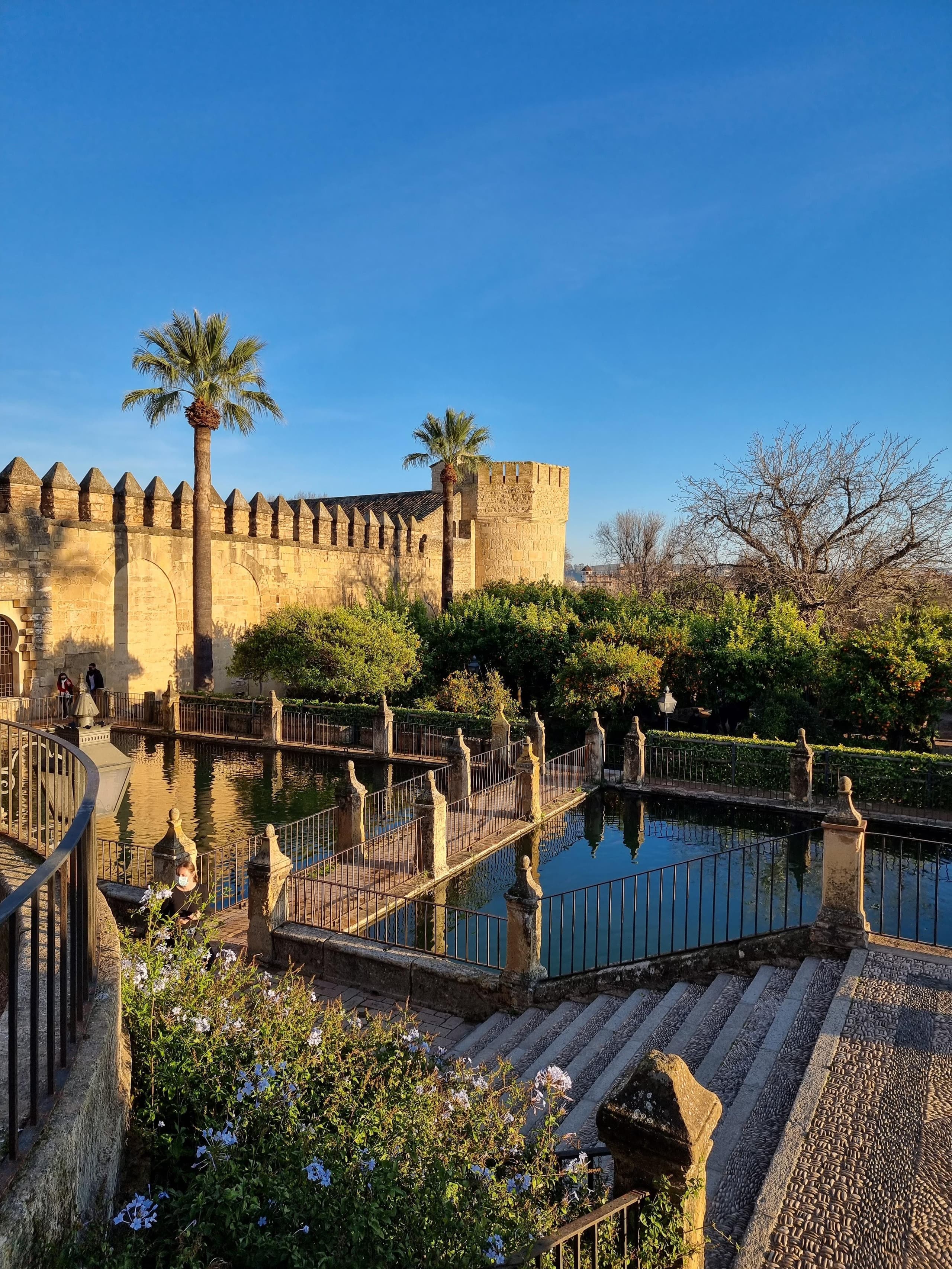
The baths of the caliphal alcázar were discovered by chance in 1903 and were part of a group of buildings belonging to the vanished alcázar of the Umayyad dynasty.
Today they are visited on the esplanade known as Campo Santo de los Mártires, opposite the Alcázar of the Christian Monarchs, and fit in as a complement within the most monumental area of the historic centre of Córdoba.
In this article you will find opening hours and tickets, including free entry, and how to organise your visit. If you choose a guided visit, ours lasts around 45 minutes, with access to the different rooms that make up the complex and a historical route through the site.
History of the baths of the caliphal Alcázar of Córdoba
The caliphal baths were built by order of al-Hakam II within the enclosure of the Andalusi alcázar, to the west of what was the city's aljama Mosque. Surrounded by a set of gardens, they were a space linked to the Islamic ritual of ablutions and also to social life.
The main core is organised as a set of rooms with different functions: an entrance vestibule, a cold room, a warm room and a hot room. Different rituals took place in each, and one of these rooms witnessed two regicides.
Over time the baths were transformed. In the period of the Taifa kingdoms they were extended by adding an annexed room to the main core. Later, in the Almohad period, another set of baths was built with its corresponding rooms, reusing the complex's boiler system.
Afterwards, when King Alfonso XI had similar baths built inside the Alcázar of the Christian Monarchs, the caliphal baths were buried and the esplanade known as Campillo del Rey was created, where military parades were held.
What you will see inside, in 4 stops that explain the complex by period
The visit is easier to understand if you follow it by historical phase, because the complex is not a single work built in one go but several interventions at different moments. These are the 4 indoor stops used to explain it.
1. Model and explanatory video
As soon as you enter, the key reference is the scale model, which places the baths in their original setting within the vanished alcázar. Right there an explanatory video also helps you understand the complex before going into the detail of rooms and routes.
2. Baths of the caliphal period
This is the main core from the 10th century. Here you follow the classic system of bath rooms, with an explanation of the purification ritual and how the rooms worked in the circuit. It is the part that sets the model on which the later extensions were built.
3. Taifa hall
It dates from the 11th century and is explained as a reception hall added to the complex, preceded by a portico that originally had a fountain at the entrance and some smaller rooms. It also serves as the passage to the later extension and brings together elements for understanding that period.
4. Baths of the Almohad period
In the 12th century a second set of baths was built alongside, with the same general structure, reusing the boiler system of the earlier bath. This stop rounds off the evolution of the complex and explains why the phases are so clearly distinguishable today.
Opening hours and tickets to visit the Baths of the Caliphal Alcázar
In winter hours, from 16 September to 15 June, they open Tuesday to Friday from 08:15 to 20:15, Saturdays from 09:30 to 17:30 and Sundays and public holidays from 08:15 to 14:15.
In summer hours, from 16 June to 15 September, they open Tuesday to Sunday from 08:15 to 14:15, with the last session at 14:00.
The general ticket costs €3.11. The reduced ticket costs €1.76 and applies to large families, youth card holders, Spanish and international university card holders up to age 26, over-65s, ICOM members, and members of the Professional Association of Museologists and the National Association of Librarians, Archivists and Museologists.
There is free entry for under-17s, unemployed people, people with a disability of 33 per cent or more plus one companion when essential for the visit, teachers, official European guides and residents of the municipality of Córdoba.
If you choose a guided visit with us, it lasts around 45 minutes, with access to the rooms and a detailed historical route as part of a complete tour.
Access to the Baths of the Caliphal Alcázar in the heart of Campo Santo de los Mártires
The Baths of the Caliphal Alcázar are in Plaza Campo Santo de los Mártires, on the esplanade opposite the Alcázar of the Christian Monarchs. They are very easy to fit into the monumental route, because they lie on the axis connecting this area with the immediate surroundings of the Mosque-Cathedral.
The visit involves going below ground: access is provided in two ways, by a staircase and also by a ramp, since the archaeological complex is preserved below the level of the square. Once on the esplanade, look for them to the west of the Episcopal Palace and halfway to the Alcázar of the Christian Monarchs.
45-minute guided visit with our complete tour of the monumental area
If you prefer to see the Baths of the Caliphal Alcázar with an ordered explanation and context, you can do so as part of our complete tour of the monumental area. The baths section lasts around 45 minutes and focuses on understanding the complex as it is organised today: first the site and its discovery are placed in context, and then you enter the different rooms to walk through them with a clear historical thread, explaining what belongs to the caliphal period, what was added under the Taifas and how it was completed in the Almohad phase. Being a guided visit, you do not just see the rooms: you follow a complete reading of the complex, room by room, without getting lost in technicalities or settling for a quick look.
Book your guided tour
Want to discover it with an official guide who explains it to you in person?