Jewish Quarter of Córdoba, the Jewish district of the historic centre
Written by official guides
The Jewish Quarter of Córdoba occupies the north-western sector of the historic centre, between the Puerta de Almodóvar and the Mosque-Cathedral, within the area declared a World Heritage Site by UNESCO in 1994. It preserves the urban layout of Islamic origin, with narrow streets and alleys that suddenly open onto small squares.
Walking through it requires no ticket or timetable: it is a living neighbourhood, with residents, shops and craft workshops among the monuments. This guide proposes an ordered walking route, with approximate times between each stop, so you do not miss any of the key points of the district.
History of the Jewish Quarter of Córdoba
The Jewish presence in Córdoba predates the Middle Ages, but the neighbourhood as it is known today took shape from 1272, when King Alfonso X the Wise authorised the Jewish community to occupy other areas of the city in addition to its original settlement next to the Mosque. From then on the Jewish Quarter extended from the Puerta de Almodóvar to the Mosque-Cathedral and the former Andalusi alcázar, with Calle Rey Heredia as its eastern boundary.
In 1478 the magistrate Francisco Valdés ordered the Jewish community to move to the Alcázar Viejo district. The measure did not last: a year later, in 1479, the residents appealed to the king and managed to return to their original neighbourhood.
The Edict of Granada of 1492 decreed the expulsion of the Jews from the kingdoms of Castile and Aragon, and the synagogue of the district changed use several times over the following centuries: first as a hospital for rabies patients under the cathedral chapter, and from 1588 as the hermitage of Saints Crispin and Crispinian. The building was declared a National Monument on 24 January 1885, after Hebrew inscriptions were found on its walls in 1876.
The historic centre of Córdoba as a whole, with the Jewish Quarter as one of its best-preserved areas, was declared a UNESCO World Heritage Site in 1994.
What to see in the Jewish Quarter of Córdoba
The most logical way to explore the Jewish Quarter is to enter through the Puerta de Almodóvar and walk towards the Mosque-Cathedral, linking the following five stops. The full route, not counting time inside the monuments, takes little more than an hour at an easy pace.
Puerta de Almodóvar
The gate stands on the site of a Roman-era access to the city and takes its current form from the medieval wall built in the 10th century, when it was known as the Jews' Gate because it gave direct access to the neighbourhood. The Christians remodelled it in the 14th century, and today it is one of only three surviving gates of Córdoba's medieval walled enclosure, together with the Puerta del Puente and the Puerta de Sevilla.
Next to it stands the statue of Seneca, a bronze by Amadeo Ruiz Olmos unveiled in 1965. A stop of about 10 minutes is enough to see the gate and the sculpture before continuing into the neighbourhood.
Calleja de las Flores
The street began as an old communal courtyard of the Andalusi period and gradually took the shape of a street after the Reconquest. Its current appearance, with the small arches and the flowerpots on the walls, is due to the remodelling of the 1950s led by the architect Víctor Escribano Ucelay; the octagonal fountain that closes it was added in 1960.
It was chosen as the most beautiful street in Spain by the magazine Tredencias in 2018 and appears among the most beautiful in the world according to Condé Nast Traveler in 2024. 10 minutes are enough to photograph it and reach the end, from where you can see the tower of the Mosque-Cathedral.
Synagogue of Córdoba
Built from 1314 and completed in 1315 on the commission of Yishaq Moheb, it is one of the few medieval synagogue buildings preserved in Spain, with Mudejar plasterwork decoration on its walls. After the expulsion of 1492 it was used as a hospital and, from 1588, as the hermitage of Saints Crispin and Crispinian, until its declaration as a National Monument in 1885.
The visit to the interior takes about 20-30 minutes. From the door of the Synagogue to the next stop, the Zoco Municipal, it is barely 5 minutes on foot along Calle Judíos.
Zoco Municipal
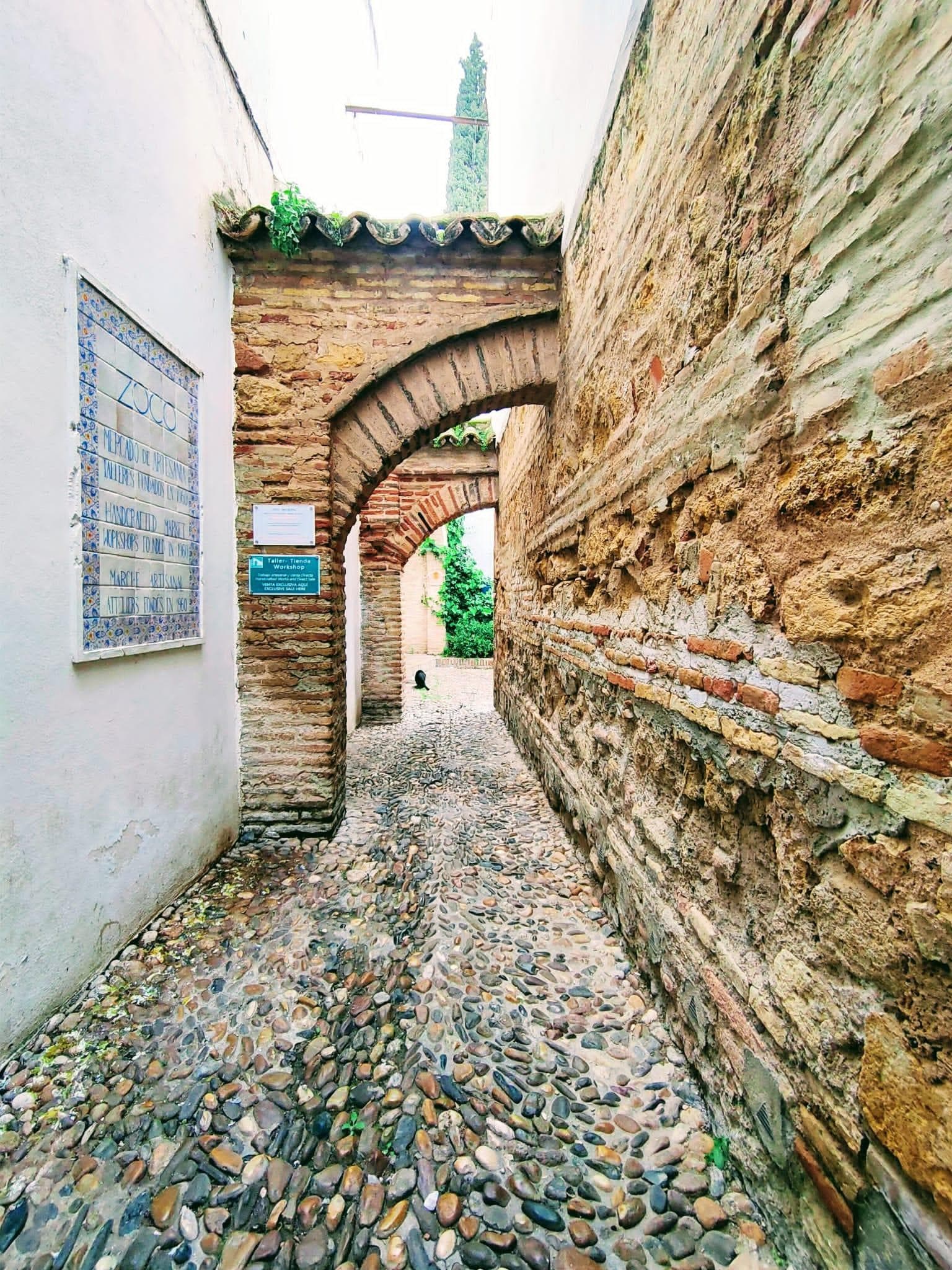
The Zoco occupies a two-storey Mudejar building arranged around a Cordoban courtyard, on Calle Judíos. It opened on 17 May 1956 as the first craft market in Spain, and today brings together workshops of leather, ceramics, silver and other traditional trades.
Entry is free and a look around the workshops takes about 15-20 minutes. From there to Plaza de Maimónides is another 5-minute stroll.
Plaza de Maimónides
The square is named after the Córdoba-born philosopher and houses the Bullfighting Museum, installed in a 16th-century manor house known as the Casa de las Bulas de la Santa Cruzada. The statue dedicated to Maimonides, a work by Amadeo Ruiz Olmos from 1964 commemorating the 760th anniversary of his death, is actually in the nearby Plaza de Tiberíades, a couple of minutes from here.
This square is a good end point for the route: from here, the Mosque-Cathedral is less than 5 minutes away on foot.
Opening hours and access
The neighbourhood itself, with its streets and squares, is public space with free access 24 hours a day, with no ticket or closing time. You can stroll through the Jewish Quarter at any time of day or night.
The monuments with their own doors are a different matter. The Synagogue of Córdoba has free entry but fixed hours: Tuesday to Sunday from 9:00 to 15:00, closed on Mondays except public holidays or the eve of a public holiday, when it also opens from 9:00 to 15:00. Groups of more than 6 people need to book in advance.
The Zoco Municipal opens every day from 10:00 to 20:00 with free entry, although the artisans' workshops only work Monday to Friday, from 10:00 to 14:00 and from 17:00 to 20:00.
How to get there
The most convenient starting point is the Mosque-Cathedral itself: the Jewish Quarter begins right on its north side, and from the Puerta del Perdón you reach the Calleja de las Flores or the Puerta de Almodóvar in less than 5 minutes on foot.
To leave the car, Parking La Mezquita is inside the Jewish Quarter itself, a few metres from the monumental complex, with more than 200 spaces and a 24-hour service. A somewhat cheaper alternative is usually Parking IC Centro Histórico, on Avenida de los Custodios, about 10 minutes on foot from the Mosque-Cathedral.
The most complete way to understand the Jewish Quarter is to combine it with a guided visit to the Mosque-Cathedral, the monument that marks the southern boundary of the district and from which the route described in this guide starts.
The guided visit in Spanish lasts 1 hour and 15 minutes, includes the ticket and costs 28 euros per person; the small-group version, with a maximum of 12 people, costs 36 euros with the same length.
If you want to get to know it with more context, the best way is to book a guided tour of the Jewish Quarter of Córdoba with an official guide.
Book your guided tour
Want to discover it with an official guide who explains it to you in person?