
Calleja de las Flores, the most photographed street in Córdoba
Written by official guides
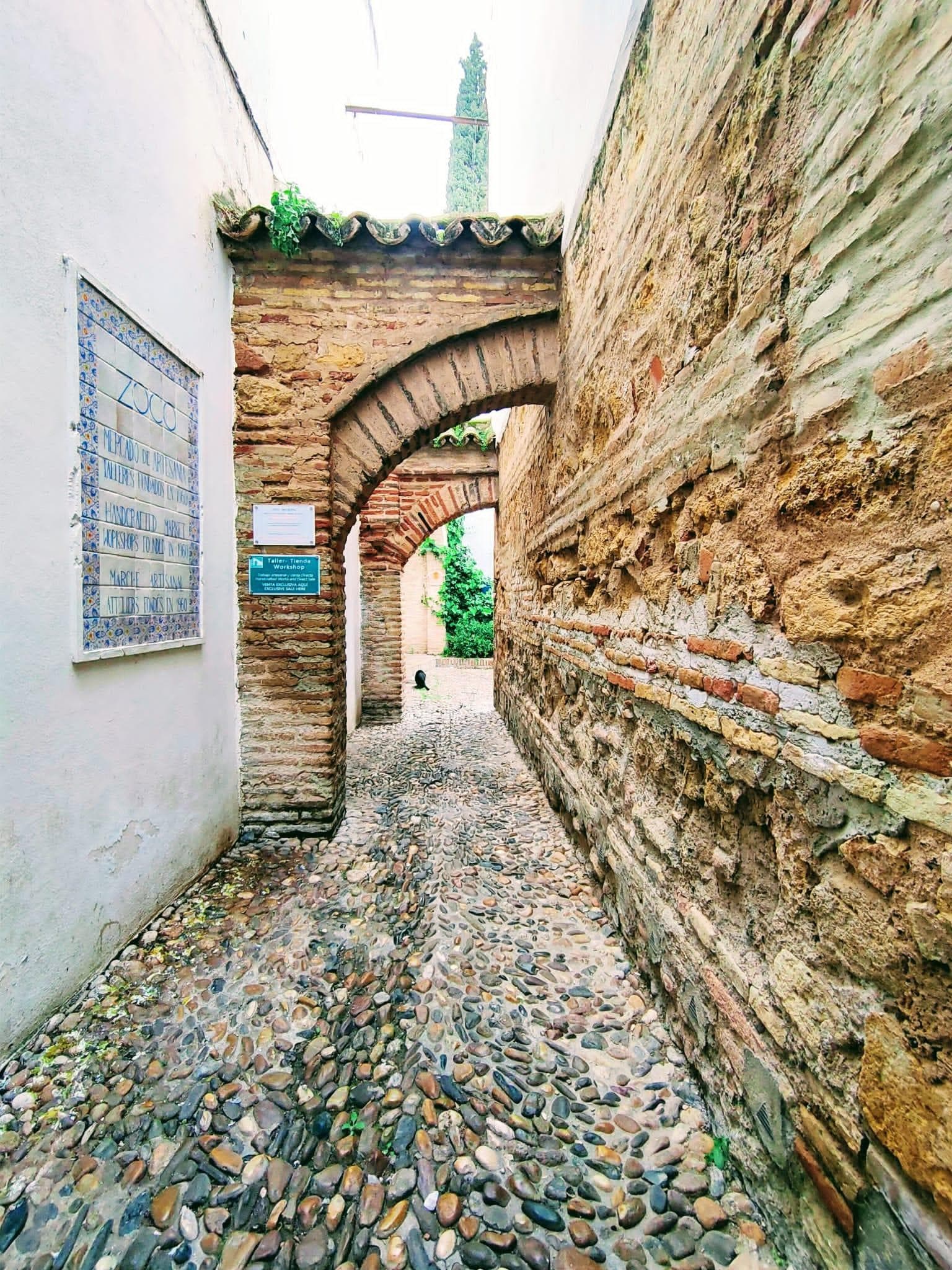
The Calleja de las Flores is, together with the Mosque, the most repeated image of Córdoba: a narrow passage of whitewashed houses and flowerpots that leads to a small square with a fountain, from where the tower of the Mosque-Cathedral peeks out. It is in the heart of the historic centre, a step from the Mosque itself, and can be visited at any time of day at no cost.
This guide brings together its history, what to see in the alley, when to go to avoid the crowds and exactly how to get there from the Mosque.
History of the Calleja de las Flores
The Calleja de las Flores began as a communal courtyard, one of the many that structured domestic life in Córdoba's historic centre. The first flowerpots were placed in September 1939, on the initiative of Felisa, mother of the resident Rafaela Tena, who began decorating the façade with her own flowers. That is why for a time it was also known as Calle de los Jazmines.
Its current appearance, the one thousands of visitors photograph today, comes from a remodelling in the mid-1950s by the architect Víctor Escribano Ucelay. It was promoted by the then mayor Alfonso Cruz-Conde, who wanted to beautify several corners of the historic centre, and carried out by his brother Antonio Cruz-Conde when he in turn became mayor. The intervention replaced the concrete slabs with traditional Cordoban cobblestones, whitewashed the façades, raised the small arches that frame the entrance today and placed a caliphal capital at the entrance to the alley.
The finishing touch came in 1960, when the sculptor Rafael Bernier Soldevilla designed the octagonal fountain that presides over the final little square, integrating the remains of a Roman column into its structure. Since then, the combination of small arches, cobblestones, flowerpots and fountain has not changed, and it is what turned the alley into one of the most reproduced images of Córdoba.
What to see in the Calleja de las Flores
The alley is short and narrow, barely a passage between whitewashed houses that climbs gently from Calle Velázquez Bosco until it opens onto a small square. In that walk of less than a minute you find the three elements that make it recognisable around the world: the fountain, the flowerpots on the façades and the view of the Mosque tower at the end.
The central fountain
The little square at the end of the alley is presided over by an octagonal fountain from 1960, by the sculptor Rafael Bernier Soldevilla, which incorporates the remains of a Roman column in its base. It is the point where almost every visitor stops, both to drink and to take the obligatory photo with the flowerpots in the background.
The flowerpots and whitewashed façades
The white lime walls, a Cordoban building tradition to keep houses cool in summer, serve as a canvas for dozens of pots of geraniums and other seasonal flowers hung on the wrought-iron railings of the balconies. The custom dates from the first flowerpots of 1939 and has been kept, neighbour by neighbour, to this day.
The view of the Mosque tower
The most photographed angle is taken standing next to the fountain, looking back towards the entrance to the alley: framed between the flowerpots and the white arches appears the bell tower of the Mosque-Cathedral, peeking just above the rooftops. It is that fit between flowers, lime and tower, not an open panoramic view, that makes the image recognisable on any postcard of Córdoba.
Opening hours and access
The Calleja de las Flores is a public street, with no gate or closing time: it can be visited any day of the year, at any time, and access is free. There is no ticket or advance booking, which is worth knowing because it is not always made explicit elsewhere.
As it is, after the Mosque, the most visited spot in the historic centre, it fills up easily in the middle of the day and, above all, at weekends and around lunchtime. The quietest time to see it without crowds and take the photo of the fountain with the tower in the background and no one in the way is first thing in the morning, before the surrounding shops open.
How to get there
The alley starts on Calle Velázquez Bosco, the street that runs along the north façade of the Mosque-Cathedral, in the heart of the Jewish Quarter. This means there is no need to check a map: walking alongside the outer wall of the Mosque, the entrance to the Calleja de las Flores appears a few metres on, marked by the gap between the whitewashed houses.
From the Puerta del Perdón, the monumental entrance to the Mosque through which you enter the Orange Tree Courtyard, the walk to the alley is barely a couple of minutes. It is, in fact, a natural stop right after the visit to the Mosque, before losing yourself in the rest of the Jewish Quarter.
The Calleja de las Flores is a step from the Mosque-Cathedral, so the logical thing is to combine the two visits in the same morning. The guided visit to the Mosque of Córdoba in Spanish lasts 1 hour and 15 minutes, includes the ticket and costs 28 euros per person; if you prefer a smaller group, of a maximum of 12 people, the option costs 36 euros with the same length.
Booking the visit first thing also makes the most of the quietest slot both in the Mosque and in the alley next door, ideal for the photo of the fountain with the tower behind and no crowds.
And if what interests you most about this corner is the flowerpots and the tradition of decorating balconies and façades with flowers, this stop fits especially well with our guided visit to the Patios of Córdoba.
If you want to get to know it with more context, the best way is to book a guided visit to the Mosque-Cathedral with an official guide.
Book your guided tour
Want to discover it with an official guide who explains it to you in person?