
Medina Azahara
5 min read
Written by official guides
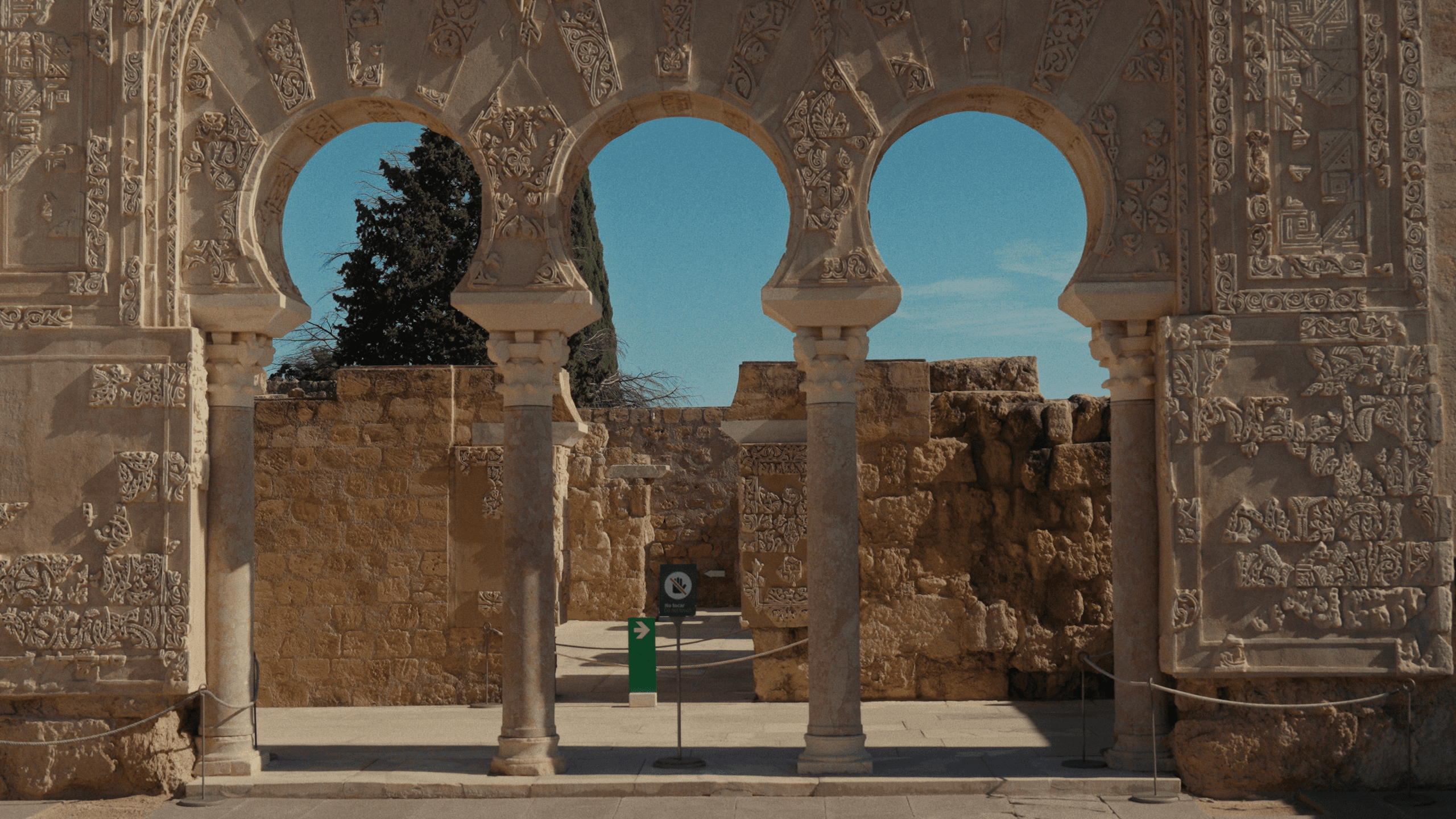
Medina Azahara is the palace city that the caliph Abd al-Rahman III ordered to be built around the year 936 at the foot of the Sierra Morena, 8 kilometres from Córdoba. It was the seat of the Umayyad caliphate of the West at its moment of greatest splendour and today is one of the most important archaeological sites in Spain, declared a UNESCO World Heritage Site.
This article covers its history, what to see at the site, the opening hours, prices and booking conditions updated for 2026, and how to get there from Córdoba.
History of Medina Azahara
Abd al-Rahman III proclaimed himself caliph in 929 and, a few years later, around 936, began the construction of Medina Azahara. According to tradition, the city took its name in honour of his favourite, Azahara, although the most recent research points to a political motive: projecting the image of a strong Umayyad caliphate of the West, capable of rivalling the Fatimid caliphate.
Construction advanced quickly: the aljama mosque was consecrated in 941, the court moved to the city in 945 and in 947 the transfer of the state apparatus, including the mint, from Córdoba was completed. The Salón Rico (Rich Hall), the most valuable room of the complex, was built between 953 and 957. After the death of Abd al-Rahman III, his son Al-Hakam II continued the works and, from 961, had the House of Ya'far, residence of his first minister, built.
After the death of Al-Hakam II in 976, power moved to Medina Alzahira under Almanzor. Medina Azahara was destroyed and looted between 1010 and 1013, during the civil war known as the Fitna of al-Andalus, barely seventy years after its foundation.
The first professional archaeological excavations began in 1911. The site was declared an Asset of Cultural Interest in 1923 and a UNESCO World Heritage Site on 1 July 2018. Today, of the 112 walled hectares of the complex, only around 10% has been excavated.
What to see in Medina Azahara
The city was organised on three stepped terraces: the upper one, with the caliphal palace; the middle one, with the administration and the homes of senior officials; and the lower one, with the population, the mosque and the markets. These are its main points.
1. The Salón Rico
Also called the Hall of Abd al-Rahman III, it was built between 953 and 957 and is, according to the archaeological complex itself, the most valuable piece of the whole site for its artistic quality and historical importance. It has a basilica plan, with three longitudinal naves.
2. The House of Ya'far
Residence of Al-Hakam II's first minister, it was built from 961. Its monumental façade, now reconstructed, has been under restoration since 1996.
3. The aljama mosque
Built between 941 and 945 outside the wall of the palace enclosure, it has a rectangular plan of 25 by 18 metres, five naves and a correct orientation towards Mecca.
4. The site museum
The visit begins here, at the visitor centre: it includes a permanent exhibition room with original pieces found at Medina Azahara and the screening of the audiovisual Madinat al-Zahra, the shining city.
Medina Azahara opening hours, prices and booking
Opening hours change several times a year. In summer, from 21 June to 20 September: Tuesday to Saturday, from 9:00 to 14:00 and from 19:00 to 24:00 (the night slot gives access only to the archaeological area); Sundays and public holidays, from 9:00 to 15:00. Closed on Mondays, except on the eve of a public holiday.
Entry is free for accredited European Union citizens; all other visitors pay €1.50.
Advance booking is compulsory only for groups of 10 or more people. If you go on your own or in a small group there is no need to book: just collect your ticket at the museum reception during opening hours.
Access from the museum to the ruins is by a compulsory shuttle bus, which leaves every 15-20 minutes and includes the return trip: €3 general rate, €1.50 reduced (children aged 5 to 12 and over-65s) and free for children under 5. The last bus leaves 60 minutes before closing. The full visit, museum and site, takes between 2.5 and 3 hours.
How to get to Medina Azahara
Medina Azahara is 8 kilometres from Córdoba, on the A-431 road, kilometre 5.5. If you come in your own car, parking is free and next to the museum.
By public transport, the most direct option is the tourist bus that connects the centre of Córdoba with the site, with stops at Glorieta Cruz Roja and opposite the Mercado Victoria. The journey takes about 25 minutes to the transfer point. The return ticket costs €10 for adults and €5 for children aged 5 to 12 (free for under-5s, and 50% discount for accredited Córdoba residents). There are departures at 10:00 (return at 13:30) and 10:45 (return at 14:15); in summer a night departure is added at 21:15 (return at 23:30).
There is also the daily bus of the Córdoba Municipal Tourism Institute, with two departures Tuesday to Sunday (three on Saturdays depending on the season) from the Paseo de la Victoria.
To make the most of the visit it is best to go first thing, especially in summer: the site is outdoors with little shade, so the heat builds from mid-morning. It is worth setting aside time for the museum before going up to the ruins: the audiovisual and the original pieces help you understand a site where 90% of the walled area is still to be excavated.
Book your guided tour
Want to discover it with an official guide who explains it to you in person?