
Mosque-Cathedral of Córdoba
Written by official guides
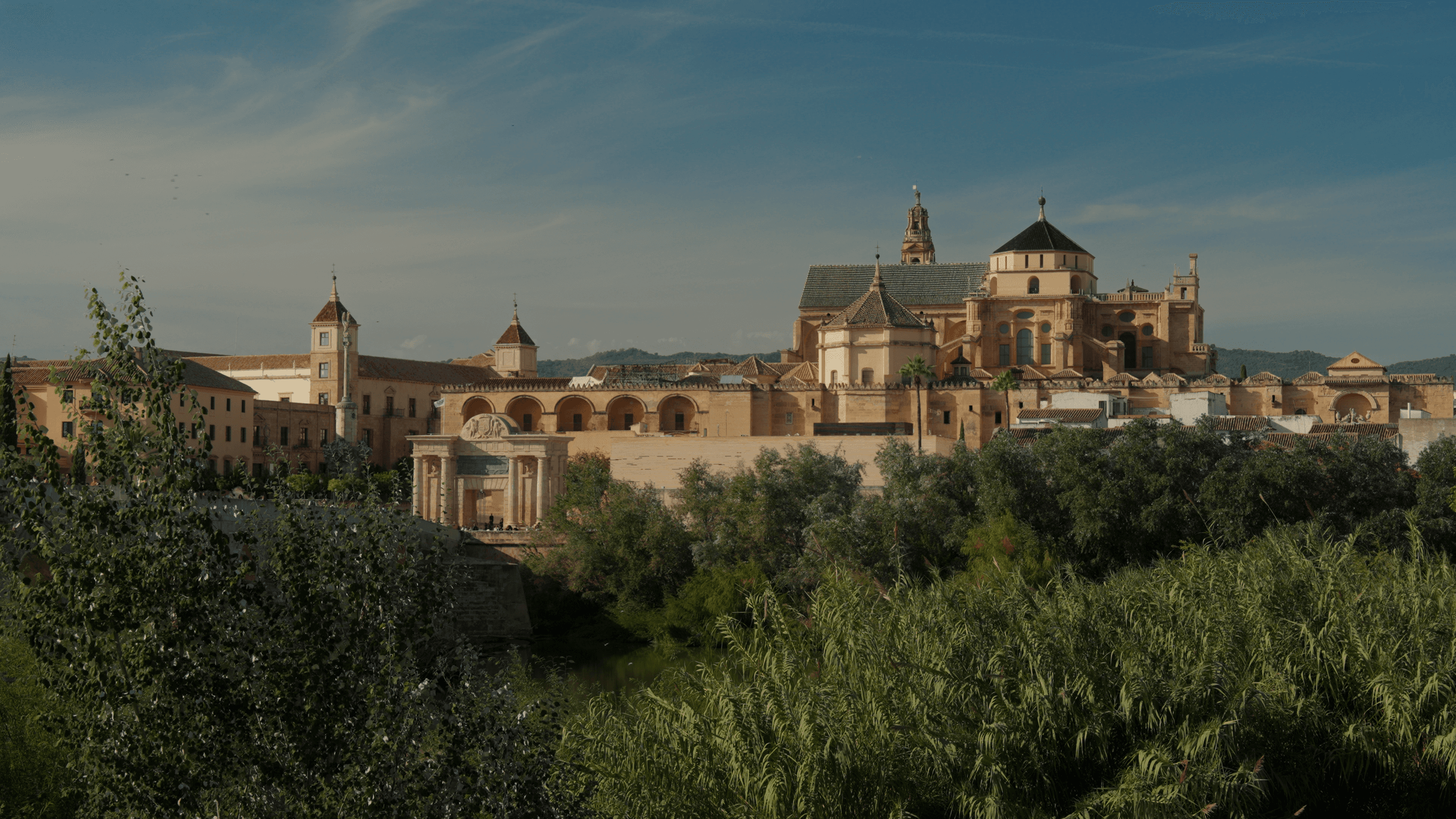
The Mosque-Cathedral of Córdoba, declared a UNESCO World Heritage Site in 1984, is one of the great symbols of the city: a temple of the Islamic West with more than thirteen centuries of history, in the historic centre, a few metres from the Roman Bridge and the Guadalquivir. Its bell tower, which encloses the remains of the caliphal minaret it was built around, the Orange Tree Courtyard and the prayer hall, that forest of arches and columns, make up the whole complex.
In this article we look at the opening hours and tickets, including free entry, and how to organise your visit. If you choose a guided visit, ours lasts 1 hour and 15 minutes with access to the Treasury and to the archaeological remains 2.5 metres below the floor, and under the rules of the Cathedral Chapter groups enter and leave with the guide.
History of the Mosque-Cathedral of Córdoba
The Mosque-Cathedral of Córdoba began to be built as the aljama mosque (the city's main mosque) from the year 786, in the context of Al-Andalus. Over time it was extended, because it was not just any oratory: it was the main mosque of the city and it had to grow with Córdoba.
In 1236, after the Castilian conquest of Córdoba, the building was consecrated as a Catholic church, and three years later it became a Cathedral. That is one of the keys to the complex: a single space that has been a place of worship in different periods and is understood today as a hybrid building.
To that base were added the great extensions of Abd al-Rahman II, Abd al-Rahman III, Al-Hakam II and Almanzor, which explain why the interior is a sum of stages. And in the 16th century the Cathedral transept was built inside, leaving the contrast that defines the Mosque-Cathedral as we see it today.
Mosque-Cathedral of Córdoba opening hours and free visit
From March to October, opening hours are Monday to Saturday from 10:00 to 19:00, and Sundays and public holidays from 08:30 to 11:30 and from 15:00 to 19:00. From November to February, it opens Monday to Saturday from 08:30 to 18:00, and Sundays and public holidays from 08:30 to 11:30 and from 15:00 to 18:00.
There is also free entry without a guided visit Monday to Saturday from 08:30 to 09:30, with clearance at 09:20; during that slot you enter without explanations or guided tours. Bear in mind that hours may change because of liturgical celebrations, special events or major religious festivities.
Mosque-Cathedral of Córdoba tickets: prices and where to buy
The general ticket for the Mosque-Cathedral of Córdoba costs €15 and the reduced ticket costs €12 for over-65s, students aged 15 to 26 and Youth Card holders with proof. Children under 7 enter free if accompanied by an adult with a valid ticket.
You can buy tickets on the monument's official website and also at the Patio San Eulogio Visitor Reception and Interpretation Centre, next to the Mosque-Cathedral, on Calle Torrijos.
If you prefer a visit with a guide, with us it costs €28 with tickets included and lasts 1 hour and 15 minutes, covering key points such as the Orange Tree Courtyard, the mihrab, the Treasury and the archaeological remains 2.5 metres below the floor; under the rules of the Cathedral Chapter, groups enter and leave with the guide.
The 5 must-sees in the Mosque-Cathedral of Córdoba
1. Orange Tree Courtyard
The visit begins in the Orange Tree Courtyard, with the guide's introduction to the Islamic period from the year 711, the dependent Emirate with its capital in Córdoba from 716, and the figure of Abd al-Rahman I (756). This links to Abd al-Rahman III (929), Medina Azahara and the minaret now integrated into the bell tower, noting that the visit to the tower is a separate route done on your own.
2. Founding mosque of Abd al-Rahman I and the forest of arches
You enter the oldest part, the founding mosque of Abd al-Rahman I (786-788), where the archaeological remains of the late-antique episcopal complex can be seen in the third nave, with mosaics visible 2.5 metres below the floor from the former basilica of Saint Vincent the Martyr. Here the guide explains the orientation towards the qibla wall, the 11 perpendicular naves and the architecture of superimposed arches, the alternation of brick and stone and the two-tone effect.
3. The Mihrab and the qibla wall
The Mihrab, built in 961 by order of the caliph Al-Hakam II, is one of the richest spaces artistically and symbolically. The guide details its decoration with tesserae sent by the Byzantine emperor Nikephoros Phokas, half-millimetre mosaics with up to 19 colours, many with gold leaf, and also explains the Treasury Door and the sabat, the raised passage that connected the Umayyad palace with the sacred wall.
4. The Main Chapel and the cathedral transept
The Main Chapel, built in the centre of the former Islamic oratory, took 84 years to complete and shows styles from Gothic to Renaissance, Mannerism and Baroque. The visit ends in the cathedral transept built between 1523 and 1603, where the different phases of construction are explained.
5. The cathedral choir and its carved stalls
The choir stands out for its carved mahogany stalls by Pedro Duque Cornejo, with a reading of their scenes and the presence of the Archangel Raphael as guardian of the city. It is one of the final points of the route before leaving through the Puerta de Santa Catalina.
How to get to the Mosque-Cathedral of Córdoba
The Mosque-Cathedral of Córdoba is at Calle Cardenal Herrero, 1, in the heart of the historic centre. It is easy to recognise by its great size and its bell tower, visible from many points, as well as its position next to the Roman Bridge and the Guadalquivir river.
The usual way to get there is on foot from anywhere in the historic centre. As traffic is restricted in the area, if you come by car it is best to park in nearby car parks and walk the last stretch. If you use public transport, bus lines 3 and 16 serve the area.
Guided visit to the Mosque-Cathedral of Córdoba
If you want a guided visit to the Mosque-Cathedral of Córdoba, with us it costs €28 with tickets included and lasts 1 hour and 15 minutes, with an official guide authorised by the Cathedral Chapter, covering the interior and the Orange Tree Courtyard, with access to the Treasury and to the archaeological remains 2.5 metres below the floor.
At the end you also receive free tickets for the Fernandine Churches, and if you want a fuller plan you can choose the complete tour of Córdoba with tickets which adds the Jewish Quarter and the Alcázar of the Christian Monarchs.
Book your guided tour
Want to discover it with an official guide who explains it to you in person?