Roman Temple of Córdoba, the temple of the imperial cult
Written by official guides
The Roman Temple of Córdoba stands next to the Town Hall, at the junction of Claudio Marcelo and Capitulares streets, in the heart of the historic centre. Its Corinthian columns, reconstructed from the original remains, are one of the most visible vestiges of Roman Córdoba and of the ancient Colonia Patricia. It can be seen from the street at no cost at any time of day.
The temple was dedicated to the imperial cult and formed part of the city's provincial forum. Today it keeps part of its podium, its staircases and several original columns, which coexist with the daily activity of Plaza de las Tendillas and the surroundings of the Town Hall.
History of the Roman Temple of Córdoba
In the summer of 1951, works to extend the town hall building brought to light Roman shafts, columns and capitals in the very centre of Córdoba. The works stopped immediately once the importance of the find was confirmed. The archaeological excavation was directed by Samuel de los Santos, then director of the Archaeological Museum, together with the architect Félix Hernández. Two years later, in 1953, the archaeologist Antonio García Bellido confirmed that the remains belonged to a Roman temple and not to mere urban decoration.
Construction of the temple had begun during the reign of Claudius, between 41 and 54 AD, and was completed some forty years later, under the emperor Domitian, between 81 and 96. On completion, the building received a water supply through the aqueduct of the Aqua Nova Domitiana Augusta. It is the only Roman temple in Córdoba of which archaeological remains have survived to the present day.
The temple formed part, together with a circus, of the provincial forum of Colonia Patricia, the name Córdoba received under Roman rule. Its function was the imperial cult, that is, the religious veneration of the emperor, a common practice in the main cities of the Empire between the 1st and 2nd centuries.
What to see at the Roman Temple
The temple is of the pseudoperipteral, hexastyle type, of the Corinthian order, 32 metres long by 16 metres wide, and built entirely of marble. From the street, free of charge and at any time of day, you can contemplate the set of columns and the podium through the perimeter railing on Claudio Marcelo and Capitulares streets. Access to the inside of the enclosure, on the other hand, is only possible during the established visiting slots, detailed in the next section.
Columns and podium
The main façade keeps six free-standing Corinthian columns, plus ten columns on each of the sides. The whole rises on a podium 3.5 metres high, reaching a total height of 9 metres. The structure incorporates anterides, fan-shaped buttresses recommended by Vitruvius and unusual in other temples of the Roman Empire.
Original staircase
The first excavations brought to light part of the central staircase that gave access to the podium, on the eastern side of the temple, together with remains of the altar and the pronaos. It is the same staircase that today allows us to reconstruct how the sacred enclosure was entered in Roman times.
Setting next to the Town Hall
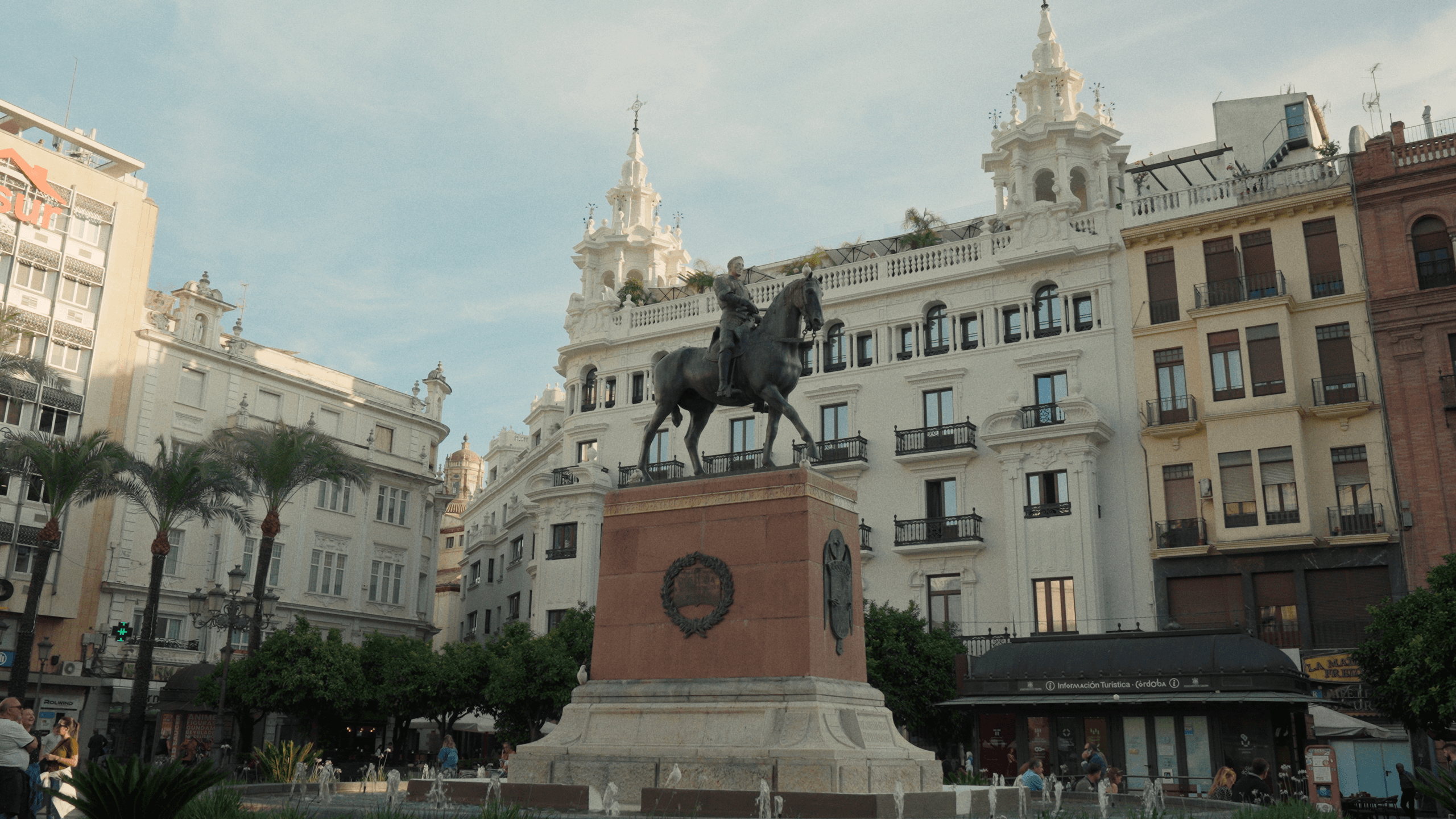
The temple occupies the same site where the town hall building was being extended in 1951, so today it shares the space with Córdoba Town Hall. Its location, a few steps from Plaza de las Tendillas, makes it an easy landmark to find while strolling through the historic centre.
Opening hours and access
The Roman Temple reopened to the public on 19 June 2025 after a restoration process. Since then, visits to the inside of the enclosure are organised in time slots, Tuesday to Friday at 10:00, 11:00 and 12:00. On Saturdays, Sundays and public holidays an extra slot is added at 13:00, and on working Mondays the enclosure is closed. Entry is free and organised on a first-come, first-served basis up to a maximum capacity of 30 people per slot, with no advance booking needed for individual visits. Groups, on the other hand, must request the visit several days in advance.
A lesser-known attraction of the temple is its night lighting. The surroundings were refurbished with a lighting system that highlights the columns and the podium at dusk and at night, with Plaza de las Tendillas and the historic centre as a backdrop. This makes it one of the most photographed corners of Córdoba outside daylight hours, something rarely mentioned in standard guides.
How to get there
The Roman Temple is on Calle Claudio Marcelo, at the corner with Capitulares, right next to Córdoba Town Hall. It is an easy spot to find for anyone already walking around the centre: just head for the Town Hall.
From Plaza de la Corredera, another landmark of the historic centre, it is a few minutes' walk along Calle Claudio Marcelo. Its proximity to both points makes it a natural stop on any walking route through the centre of Córdoba.
The Roman Temple is within the monumental area of Córdoba, near the Town Hall and Plaza de la Corredera, but some way from the Mosque-Cathedral. The most complete way to see it within a route through the historic centre is the free tour of Córdoba, free with a voluntary tip of 10 to 15 euros per person and lasting about 2 hours, covering the key points of the Roman and medieval city, including the surroundings of the Town Hall.
When you finish your visit to the Roman Temple of Córdoba, the most convenient thing is to make the most of being in the centre and continue with a guided walk through the centre of Córdoba to give context to the rest of the city without changing area.
If you want a direct, light option, the free tour of Córdoba lasts 2 hours and is free. If you prefer a long route with more stops, the complete tour of Córdoba with tickets lasts 3 hours 30 minutes and costs from €44.
Book your guided tour
Want to discover it with an official guide who explains it to you in person?